New Flyer – We Should Run Our Workplaces

We have another new flyer ready to share with the world! We Should Run Our Workplaces lays out an argument that capitalism and the state should be abolished and the economy should be run from the bottom up, by workers and for workers. It is designed to be easy to print on a work or home printer, being a single sheet of folded A4, so feel free to print your own. It is available along with all our flyers in more versions, like block black and white and booklet, in our Materials and Flyers page.

OWNERS AND WORKERS

Today the economy is divided into two broad classes of people. One is a small elite who control the vast majority of the wealth, organisation, and productive capacity of society; private business owners. The other is the majority of workers who have little independent access to the means of survival and must work for one of these private owners in order to make the money we need to live. This structure has put workers in a position in which we must accept mistreatment by our employers or risk the insecurity and poverty of unemployment, and as such it is called “capitalism” as it is a system in which those who own the means of production, or capital, run the economy.

Many workers trapped in this economic structure hate their jobs. Even many workers who enjoy their work and the more farsighted owners can see that capitalism is often harmful. However, capitalism is treated as either a fact of nature or the best of all available options. This pamphlet challenges the idea that our current economic system is natural or optimal, suggests an alternative way of managing the economy, and lays out how we can get there.

A HISTORY OF VIOLENCE

Much of our acceptance of capitalism rests on a myth that it developed out of the free choices of everyone. In this myth, people were liberated from the previous medieval system based on peasants paying compulsory tithes to lords and priests, and everyone was free to associate, work, and trade on an open market. Some people became richer through their superior vision or work ethic and came to own much of society’s wealth. Having risen to their position based on their abilities, this new ruling class of capitalists were the best people to run the economy. Their position is a result of the free choices of people on the market and any attempt to restrict them will involve restricting freedom for everyone.

However, capitalism is not the result of freedom but the result of violence and oppression. In many places, including Britain, the creation of capitalism involved vast amounts of violent theft from common people by the ruling class, with the medieval peasantry being kicked off their own land by the aristocracy, who turned that stolen land into their private property and turned themselves into capitalists. The exact methods of this theft change from place to place, but nowhere has there ever been a free market out of which a capitalist ruling class naturally developed on the basis of their own merits.

From these origins, capitalism has continued to require violence to maintain itself. From governments directly aiding capitalists with police or military violence, to more subtle forms of support such as favourable regulatory frameworks or subsidies ultimately enforced by a police baton or soldier’s bullet. Likewise, large corporations are always heavily involved in politics; funding politicians in exchange for favours, running government services, supplying goods, and hiring from government bureaucracies.

WORKPLACE DICTATORSHIP

Capitalism is also incompatible with the values it claims to be based on. While it appeals to the liberal ideals of freedom and democracy, capitalist workplaces are strict hierarchies that answer to the dictatorship of the owner and workers exist as resources to be controlled without any real say in how the organisations we rely on for work are run.

This lack of freedom has a real impact on the lives of workers. We end up living a significant part of our lives not for ourselves, but for our employers. What we learn, who we know, where we live, and when we are free are all set by the demands of our jobs. Our employers get the best hours of our day for most of our lives and we retire only once we are worn out and no longer of any use to capitalism. This is the case even in “good” jobs. In bad jobs, where pay is bad, and the bosses are abusive or negligent, we can suffer all kinds of mistreatment which we often accept because we can not afford to quit.

Capitalist owners also have competing interests with their workers. Workers want a decent wage that we can live on, and we want working conditions that allow us to work and live with dignity. However, high wages and good working conditions are costs that eat into the profits for the owner, and any business that does not produce profit is not worth running. Since the owner has the power in this relationship, workers end up not being treated like people, but tools to make the rich ever richer, and we only get to live insofar as we can be good tools to that end.

These problems are the core cause of many of the other problems we face today. The capitalist need for profit results in a constant drive for lower wages, higher prices, and generally worse living conditions. The vast amounts of wealth that capitalists hoard and their key role in running the economy mean that they also have significant political power and are able to bribe or intimidate governments into serving their needs. Because these profits are often guaranteed by state violence, individual workers have very little power to push back against these worsening conditions. Capitalism means that modern society, despite being many times richer than any previous society, does not provide a basic level of human dignity for all of its members.

MORE MONEY THAN SENSE

Capitalism is also justified as being economically efficient. It may suck for many workers but this is the price we pay for the wonders of modern society. But this is also a myth, as many supposedly “efficient” businesses are bureaucratic nightmares, run by people who have no idea what is happening below them.

Part of the reason for this is the sheer size of many businesses. Past a certain point, a corporation becomes too large for anyone to know how it functions regardless of their level of business genius or technical expertise. The power imbalance between owners, their managers, and workers also means that people lie to their superiors to protect themselves, worsening this ignorance at the top. Anyone who has worked for a large organisation at its lower levels will know that day-to-day operations are often more reliant on front-line staff ignoring orders to get things done than on visionary leadership from above.

However, the conflict of interest between workers and owners is also a massive cause of inefficiency. Workers who think and act for themselves will always tend towards working towards their own interests and do as little as possible for their pay. On the other hand, workers who have been crushed down into obedient tools will lack drive, initiative, and the will to push back against, or work around, counterproductive commands from above. Capitalist organisations will always tend towards being run by people out of touch with reality and staffed by workers who are either in a state of rebellion or a state of apathy.

WORKER CONTROL

The solution to these problems can’t be found within capitalism as they arise from the very structure of ownership at the core of capitalism. Instead, they can only be solved by changing that structure of ownership and putting control of the means of production into the hands of workers. Only when workers control the day-to-day running of the organisations we rely on for our livelihood can that reliance not be used to exploit and oppress us.

Worker control would also remove the internal conflicts that cause problems in capitalist businesses. When workers are the collective managers and owners of our workplaces, there is no conflict of interest between worker, manager, and owner. Without this conflict, there is no reason for workers not to cooperate and share information for our own mutual benefit, and no need for a management hierarchy to keep people in line. Likewise, without the ability of individuals to make ever more money from ever larger businesses, there is no reason for organisations to grow larger than is economically efficient from the perspective of serving their workers and consumers.

The first response to this is often that such a change in ownership would be theft from the capitalists. But as already discussed, the current ownership structure is itself based on historic theft from peasants, workers, and other lower classes. Returning the ownership of the means of production to the descendants of those dispossessed people would be an act of justice, not theft. The second response is that workers do not know how to run businesses. But in most businesses, neither the management nor the owners really know how to run the business and it is the workers who actually keep the business functioning.

Such a change in ownership would change the very foundations of our society and would abolish capitalism in the sense that capitalists, as a class of people who own most of the capital, would not exist. Likewise, the working class, as defined by having to rely on capitalists to employ us in order to survive, would also cease to exist, as we would collectively own and run our workplaces. Society would not be run by a privileged class, but by its members in general as free equals; everyone would have a say on the running of the means of production and infrastructure that we rely on in order to survive.

SOCIALISM AND THE STATE

Worker control of our workplaces and society is not a new idea; it was the core demand of the old socialist movements. But these movements relied on the state to control the means of production for workers and so the government, not workers, ended up as the real owner of our workplaces and society. This put workers in the same position of disempowerment as we face under capitalism; someone else controls access to what we need to work and live, and so can control, oppress, and exploit us.

While the state does not have the same profit motive as private businesses, its structure still encourages oppression and exploitation. All states are built on the obedience of their subjects without which the rulers of the state have no power. A working class that is too wealthy and too free-thinking to be easily controlled is a threat to that obedience. Likewise, the politicians and technocrats who seek power within the state must gather resources to battle each other for power and those resources must be extracted from the working class. Workers who have worked for government departments will know that they can be just as abusive and incompetent as private businesses. Even the most democratic states suffer from these problems, with a theoretically perfect democracy only empowering the majority to exploit and abuse minorities.

If workers are to take control of society and our own lives, we need to do so from the bottom up. We need to run our workplaces, our housing, and the utilities we rely on directly, based on consensus wherever possible. To run the economy as a whole, we need these worker controlled workplaces and community controlled infrastructure projects to cooperate together in networks, alliances, and federations which are run on the basis of bottom up free agreement instead of being imposed from the top down on the basis of rulership and obedience. Only when society is organised in this way can workers claim to really own the means of production.

ANARCHO-SYNDICALSIM

In order to achieve this kind of control, workers need to build our own organisations from the bottom up, independent of the state and capitalism. We need to build radical unions in our workplaces and community organisations, like renters’ unions and mutual aid groups in our neighbourhoods. These organisations can fight for higher pay, lower rents, and better living conditions through strikes, boycotts, and protests. By being local and decentralised they can be run by workers without creating a new hierarchy of rulers over us.

However, these organisations must have aims beyond just winning a higher wage in a particular workplace or preventing an eviction in a particular community. By linking these organisations together on the basis of mutual cooperation they would have the ability to launch strikes and boycotts across entire industries or countries. Such power could be used to oppose larger problems like unjust laws or the bad behaviour of large corporations. Once sufficiently developed such an alliance of workers’ organisations would have bottom up control over the economy and society, could use that control to do away with both the state and capitalism, and truly put workers in control of society.

This approach to change has a name. Because it rejects all authority and rulership, it is anarchist, which literally means without (an) rulers (archy). Because it rejects the use of the state for political change and seeks to build working class power through organisations in the workplace and the community, it is syndicalist, which comes from the French word for a workers’ union. Together, these two ideas form Anarcho-Syndicalism.

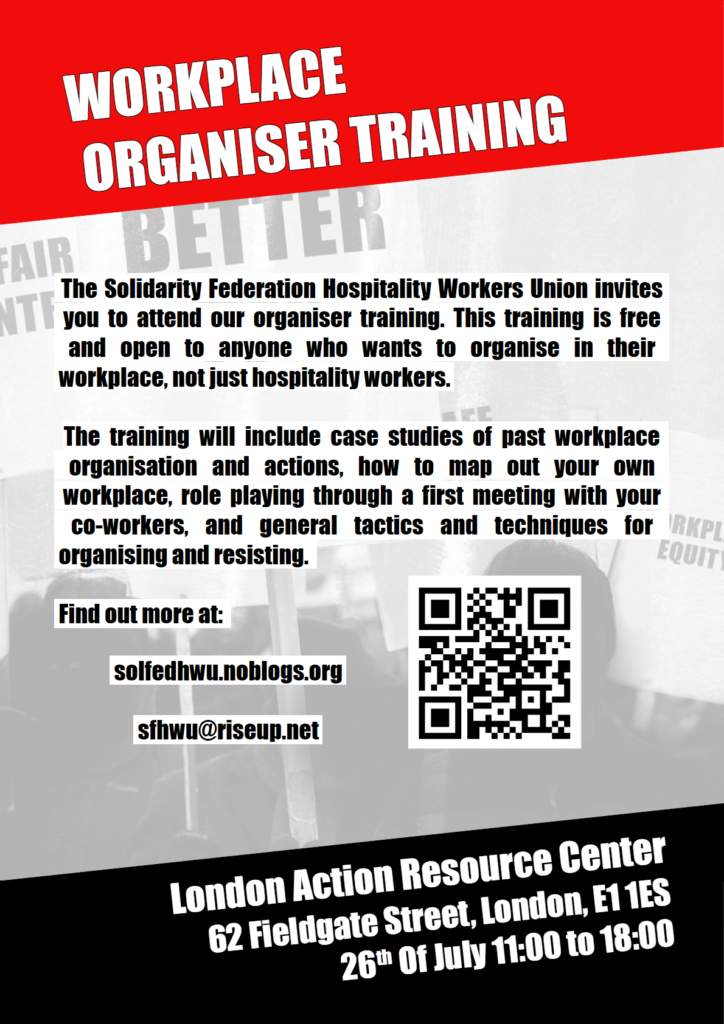
Hospitality Organising Meeting

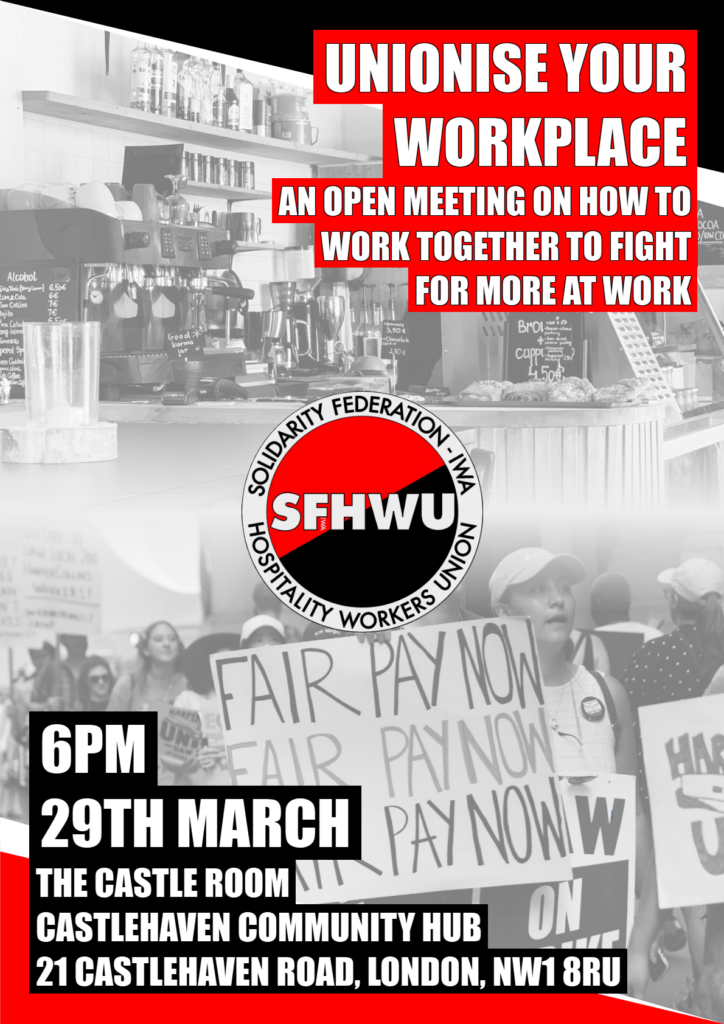
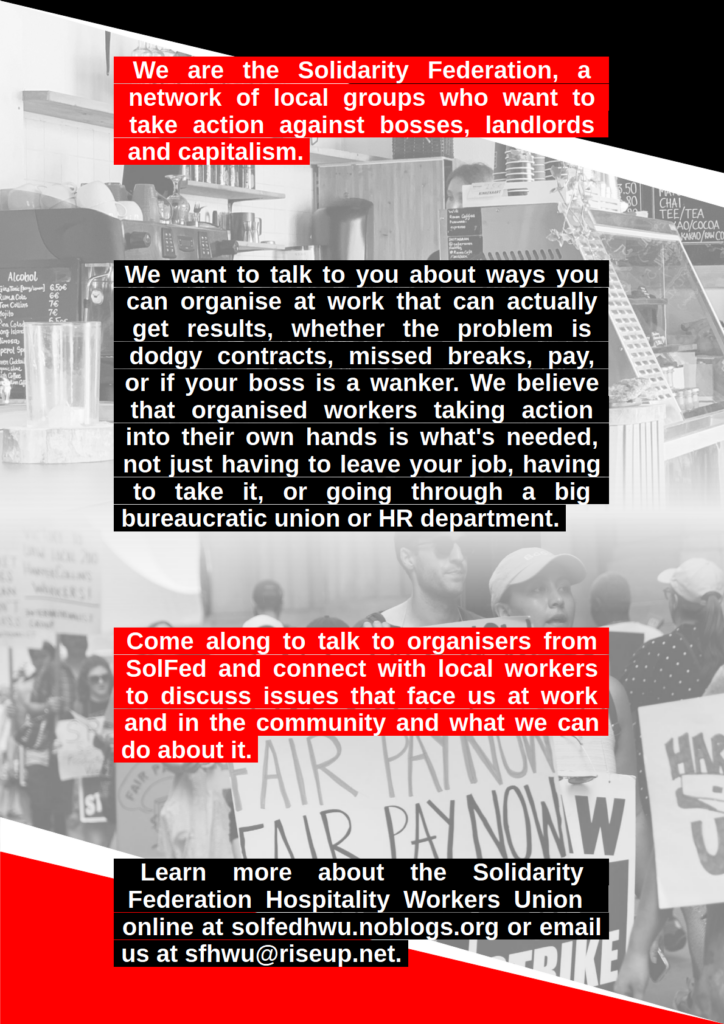
We will be holding an open meeting on the 29th of March for hospitality workers who want to organise a union in their workplace. We will talk about ways people can organise at work that can actually get results, whether the problem is dodgy contracts, missed breaks, pay, or a wanker boss.

We believe that organised workers taking action into their own hands is what’s needed, not just having to leave your job, having to take it, or going through a big bureaucratic union or HR department. Come along to talk to organisers from SolFed and connect with local workers to discuss issues that face us at work and in the community and what we can do about it.

Although the meeting will be in Camden, London and that is the area we will be flyering in, if you work in a bar, cafe, restaurant, hotel or other hospitality venue and want to organise in your workplace, please get in contact with us wherever you are. We will also need people to help us flyer and otherwise spread the word, so please also get in contact if you want to help.

The meeting will be at 6pm, 29th of March, in the Castle Room at the Castlehaven Community Hub, 21 Castlehaven Road, London, NW1 8RU.

Transphobic Networks in The Workplace

In mid 2025 it came to the attention of Solidarity Federation (SolFed) in London that transphobes were organising in the workplace under the banner of the Sex, Equality, and Equity Network (SEEN). A brief look at SEEN made it clear that this network was “gender critical”, or transphobic, but attempting to hide it behind a mask of fake feminism and liberal civility. London SolFed did some additional research into SEEN and produced a report for the wider federation in November 2025. This is a lightly edited version of that report for wider consumption.

We had initially intended to do a far more detailed report than this one, but it quickly became clear that this topic was beyond our capacity to cover in depth. We found 21 different transphobic professional associations operating in various industries, all networked together and into the wider transphobic milieu but without any formal central organisation. This represents a serious attempt to spread and defend transphobia in the workplace on a scale which we can not do a detailed analysis of in timely manner. Instead, we hope this broad overview still proves useful and that other can use this as a basis for their own work.

This report is based off of what can be found out about these associations from browsing their websites and social media accounts. This puts serious limits on what we can say about the on-the-ground composition and activity of each of these networks. Are these astroturfed organisations with no real presence in any workplace? Do they represent a membership scattered across each industry? Do they represent a membership concentrated in specific workplaces within each industry? These are important questions that can not be answered without a more specific, in-depth, and hands-on investigation into each of the individual networks.

Likewise, we can not make a firm judgement to the degree to which these associations meaningfully cooperate. While they lack a formal overarching organisation, the extent to which they are tightly organised along informal lines is something that is hard to say from the kind of broad but shallow investigation we have presented here, beyond the limited information that can be gained by looking at who is sharing who on social media, and announcements of open joint events.

A Brief History of SEEN

Most of these associations uses a similar SEEN branding, however there are a few associations that pre-date SEEN. The first of these professional associations, at least the first we could find that is still active, was the Evidence-Based Social Work Alliance (EBSWA) which now also goes by SEEN in Social Work, set up in 2020.

The next wave of associations came out of the healthcare sector. Thoughtful Therapists was founded in early 2021 and in 2024 launched a spin-off project, Just Therapy, which is a network of therapists which believe “much of the world of psychotherapy and counselling has been taken over by activists and ideologies”. With Woman, an association of maternity and women’s healthcare workers, was also founded in early 2021. The Clinical Advisory Network on Sex and Gender (CAN-SG), a doctors’ association, seems to have been founded in early 2022 and Transgender Map has done their own research into them, describing them as “an anti-transgender front group” who are “heavily involved in trying to stop NHS from conducting clinical trials on puberty blockers.”

These pre-SEEN associations have remained fairly active in terms of their online presence with well maintained websites, active social media accounts, and offer an unfortunate wealth of propaganda and other resources. From what can be seen on their social media accounts they are also networked with each other, the later SEEN associations, and the general transphobic milieu, with at least members of With Woman attending a 2024 meeting of transphobic professional associations.

In late 2022 the original SEEN network was founded as a professional association for civil servants. This seems to be an important moment in the birth of this broader network as all of the associations following this one share a general SEEN branding. Early 2023 then saw the launch of SEEN in the city, a network for people working in finance. After a gap of a year there was then an explosion in organising under the SEEN banner. In the first half of 2024 networks were launched for police, HR, parliamentary workers, science and technology, journalism, sport, schools, health, local authority workers, publishing, trade unions, and the Church of England. Third Sector SEEN then launched in late 2024 and SEEN on Campus launched in mid 2025.

All of these SEEN networks maintain a similar style and look and many of them have links on their sites to other SEEN networks. While there is no obvious coordinating organisation between these networks, the common branding and the fact that their seemed to be a concerted campaign to launch these networks in 2024 implies a significant level of informal coordination. From looking at the social media of these networks, they share content from the usual transphobic personalities and organisations and seem to be well embedded in that wider network. Of special note in this broader network is the charity Sex Matters which regularly puts up information about how to push transphobia in the workplace, hosted the previously mentioned meeting of transphobic professional associations, and also maintains a list of these associations that cover not just the SEEN networks but also the earlier associations that were launched before the SEEN branding became the dominant style among them.

Activity

Not all of these associations have been equally successful. Some already seem to be inactive with seven showing low levels of activity online, including the original civil service SEEN. Five more are moderately active online but do not seem to have developed much reach. The journalists network seems to be the most successful single network, with a publishing network also active that likely has some overlap. The healthcare sector is also a place of strength for these networks with not only an active SEEN network but also three active pre-SEEN associations. Combined, these associations probably rival the journalism network, although they have also had far longer to build up. The next most active seem to be the police, social work, and sport. Based on where it is most active, the SEEN network probably draws its support from the class of technocratic professionals with little clear reach into the rank and file working class.

In terms of the style of propaganda put out by these networks, they take great pains to avoid being open transphobes, emphasise that their views are legally protected, and attempt to pass themselves off as just concerned about “sex based rights”. This kind of tone likely sounds quite reasonable to people who do not know what they are looking at. The below quote from the original civil service SEEN’s about page represents this general tone well:

The focus of our network is on challenging sex discrimination and upholding rights and protections that relate to sex (including the protections provided to those with the protected characteristics of sex, pregnancy and maternity and sexual orientation, as set out in the Equality Act 2010). We recognise that to achieve this and ensure sex equality and equity sometimes requires treating women and men differently, according to our different rights and needs.”

In terms of activities, these associations seem to mainly devote themselves to various forms of lobbying, professional networking, propaganda, and developing resources such as form letters and legal advice. Campaigning over controlling access to toilets seems to be a common activity among many of these associations, along with defending people who have come under pressure for transphobic attitudes and actions.

Causes for Concern

Even the most successful of these transphobic professional associations are probably still quite small but we think they pose a real threat in a variety of ways. Firstly, they are trying to build networks in sectors in which professionals have a lot of day to day power over trans people: healthcare, policing, social work, education, and government. In these sectors individual professionals or managers often have the capacity to ruin the lives of trans people just by the nature of their position, and a network of transphobic professionals has the capacity to help empower and defend its members even if they lack any kind of mass movement in the general workforce.

Secondly, transphobic opinions are already massively over-represented in the media compared to the size of the transphobic milieu and SEEN networks have a well developed shared propaganda approach that makes them look as reasonable as they can given the implications of their actual ideas. I can see this approach leading to quit a few people who are not tuned in to what exactly they are looking at treating these SEEN networks as genuinely concerned with feminism and any attacks on them as attacks on feminism. The strength of SEEN in Journalism gives the network further propaganda advantages over any union or political group that may end up confronting them. Any counter-propaganda will have to be very careful and take pains to point out the actual implications behind all their polite wording and the links that they have to other transphobic organisations that are not as consistently slick in their messaging.

Lastly, given that transphobia is rapidly becoming a point of shared agreement among the ruling class of this country, with both Labour and the Conservatives being various forms of terrible on the issue and Reform being on the rise, it is possible that these networks will be able to punch well above their weight in terms of influence. While they may not represent a mass movement of workers, if they represent views that high level managers, capitalists, and politicians already agree with then they will be able to call on the power of state and capital without the need to develop a true broad based mass movement.

Given that much of the SEEN network was only set up in 2024, possibly by a coordinated campaign, it is also worth considering that we have not seen the end of attempts to set up new associations or that currently low activity associations may be able to build into more active organisations. Even the oldest of these associations is only five years old, so it is hard to judge from what we have already seen just how far these networks could expand. We also do not know what has driven the creation of these networks and what resources were required to build them up to their current level. If they are a grass roots development from transphobic professionals that has so far been built on limited resources, they could become far more dangerous if they find a rich and powerful benefactor that can give them serious funding and connections.

In any case, these networks provide yet another reason to be organised in our workplaces and to organise not just on the basis of pay and conditions but around broader social and political concerns. Transphobes need to get in the bin and given how transphobia is increasingly becoming political common sense among our rulers, it will come down to everyday people organising and fighting in our workplaces and our neighbourhoods to get it done.

Appendix

Below is a list of details on the transphobic professional associations we could find, with notes on their social media presence and activity online. Accurate as of November 2025.

EBSWA/SEEN in Social Work
Sector: Social Work
Founded: November 2020
Activity: High
Presence: Website – Fleshed out, Twitter – 4,400 followers, Facebook – 100 followers, YouTube – Inactive

With Women
Sector: Healthcare
Founder: February 2021
Activity: Medium
Presence: Website – Fleshed out, Twitter – 6,800 followers

Thoughtful Therapists
Sector: Healthcare
Founded: March 2021
Activity: High
Presence: Website – Fleshed out, Twitter – 6,500 followers

CAN-SG
Sector: Healthcare
Founded: February 2022
Activity: High
Presence: Website – Fleshed out, Twitter – 5,100 followers, YouTube – 290 followers

SEEN
Sector: Civil Service
Founded: October 2022
Activity: Low
Presence: Website – Fleshed out, Twitter – 2,500 followers

SEEN in the City
Sector: Finance
Founded: February 2023
Activity: Medium
Presence: Website – Bare bones, Twitter – 1,900 followers, LinkedIn – Company page

Police SEEN
Sector: Police
Founded: January 2024
Activity: Medium
Presence: Website – Bare bones, Twitter – 7,000 followers

SEEN in HR
Sector: Police
Founded: January 2024
Activity: Medium
Presence: Twitter – 2,800 followers, LinkedIn – 1,400 followers

SEEN in Parliament
Sector: Government
Founded: February 2024
Activity: Low
Presence: Twitter – 1,400 followers, Linktree – Bare bones

SEEN in STEM
Sector: Science and Technology
Founded: March 2024
Activity: Low
Presence: Twitter – 1,400 followers

SEEN in Journalism
Sector: Media
Founded: March 2024
Activity: High
Presence: Website – Unremarkable, Twitter – 21,400 followers, Substack – 2,500 followers, Has a podcast

SEEN in Schools
Sector: Education
Founded: March 2024
Activity: Low
Presence: Twitter – 1,600 followers

SEEN in Retail
Sector: Retail
Founded: March 2024
Activity: Low
Presence: Website – Unremarkable, Twitter – 1,100 followers

SEEN for CoE
Sector: Church
Founded: March 2024
Activity: Low
Presence: Twitter – 350 follower

SEEN in Sport
Sector: Sport
Founded: April 2024
Activity: Medium
Presence: Website – Unremarkable, Twitter – 4,900 followers

SEEN in Health
Sector: Healthcare
Founded: April 2024
Activity: Medium
Presence: Website – Fleshed out, Twitter – 3,600 followers

Local Authority SEEN
Sector: Government
Founded: April 2024
Activity: Medium
Presence: Website – Unremarkable, Twitter – 1,900 followers

SEEN in Publishing
Sector: Media
Founded: May 2024
Activity: High
Presence: Twitter – 4,600 followers, Substack – 620 followers

TU SEEN
Sector: Trade Union
Founded: July 2024
Activity: Medium
Presence: Twitter – 1,600 followers, Substack – 100 followers

Third Sector SEEN
Sector: NGO
Founded: September 2024
Activity: Low
Presence: Twitter – 1,600 followers, Substack – 100 followers

SEEN on Campus
Sector: Education
Founded: August 2025
Activity Low, but in formation
Presence: Website – Bare bones
Stand up To All3

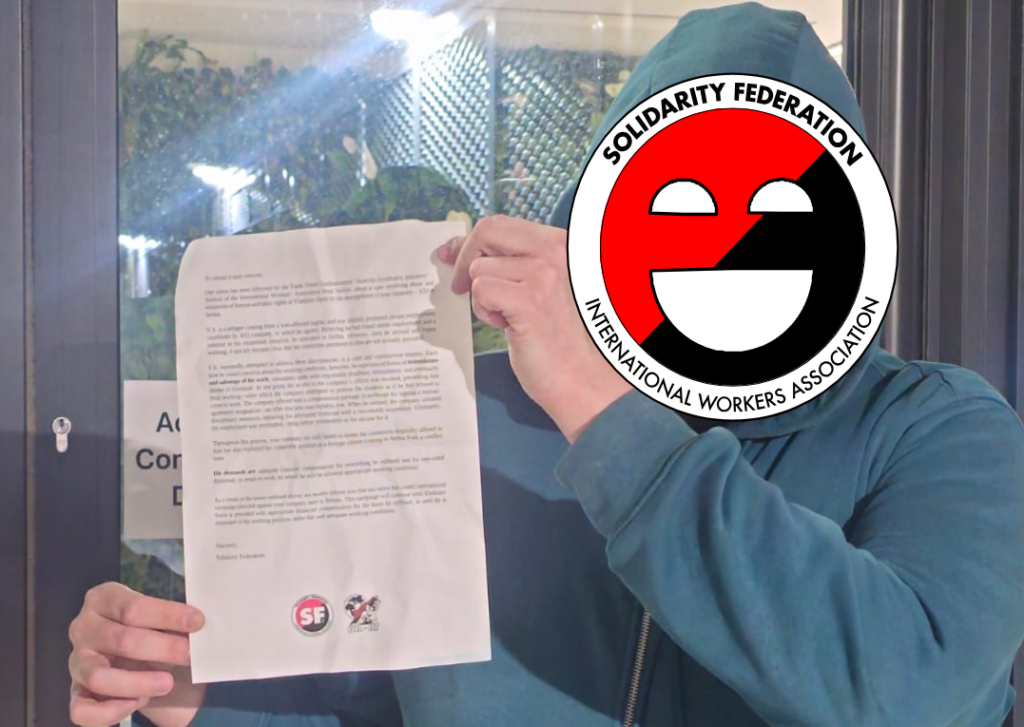
Yesterday we delivered a letter to the company ALL3 in London on behalf of our comrades in the Serbian Anarcho-Syndicalist Initiative (ASI). ALL3 in Serbia have taken advantage of a worker’s precarious immigration status, ultimately leading to their wrongful dismissal, and we stand in solidarity with our comrades against this unfair treatment. Full letter below:

” To whom it may concern,

Our union has been informed by the Trade Union Confederation “Anarcho-Syndicalist Initiative” – Section of the International Workers’ Association from Serbia– about a case involving abuse and violations of human and labor rights of Vladislav Surin by the management of your company – All3 in Serbia.

V.S. is a refugee coming from a war-affected region, and was initially promised certain employment conditions by All3 company, to which he agreed. Believing he had found stable employment and a solution to his existential situation, he relocated to Serbia. However, once he arrived and began working, it quickly became clear that the conditions promised to him are not actually provided.

V.S. repeatedly attempted to address these discrepancies in a calm and constructive manner. Each time he raised concerns about his working conditions, however, he experienced forms of intimidation and sabotage of his work: unrealistic tasks with impossible deadlines, intimidation, and eventually threats of dismissal. At one point, his access to the company’s offices was revoked, preventing him from working—after which the company attempted to present the situation as if he had refused to come to work. The company offered him a compensation package in exchange for signing a mutual-agreement resignation—an offer that was unacceptably low. When he refused, the company initiated disciplinary measures, replacing the attempted dismissal with a two-month suspension. Ultimately, his employment was terminated, citing untrue information as the excuse for it.

Throughout this process, your company not only failed to honor the conditions originally offered to him but also exploited his vulnerable position as a foreign citizen coming to Serbia from a conflict zone.

His demands are: adequate financial compensation for everything he suffered and for one-sided dismissal, or return to work, on which he will be allowed appropriate working conditions.

As a result of the issues outlined above, we hereby inform you that our union has joined international campaign directed against your company here in Britain. This campaign will continue until Vladislav Surin is provided with appropriate financial compensation for the harm he suffered, or until he is reinstated to his working position under fair and adequate working conditions.

Sincerely,

Solidarity Federation”

New Flyer – Towards a Better Union

We have a new flyer ready to share with the world! Towards a Better Union lays out a critique of mainstream trade unionism and argues for a specifically anarchist and syndicalist approach to workplace organizing. It is designed to be easy to print on a work or home printer, being a single sheet of folded A4, so feel free to print your own. It is available along with all our flyers in more formats, like block black and white and booklet, in our Materials and Flyers page. Full plain text available below the pdf on this post.

A BLEAK FUTURE

The trade union movement has been extremely important in furthering the desires of workers and improving our living conditions. This movement was vital in raising many workers out of the gruelling fourteen hour days, unsafe working conditions, poverty pay, and general degradation of the industrial revolution.

However, the modern trade union movement seems unable to extend or defend those gains. For many workers, the next decade looks like it will be bleaker than the last, and in the long term we may be slowly sliding back to the soul crushing working conditions of the 19th century. In the face of this, modern unions often seem to lack the ability to effectively stand up for their members. They are also often wracked with problems of internal abuse and a lack of accountability to their membership.

This pamphlet will argue that this failure is inherent to the way that modern unions are structured, and that in order to defend the interests of the working class we need to build a better kind of union with a radically different structure. However, before that, we will explore why the trade union movement developed in the first place and what the purpose of those early unions was.

CAPITALISM

Trade unions developed as a reaction to the growth of capitalism. Before capitalism, most families were broadly self-sufficient, either working the land as peasant farmers or creating things for sale with their own tools as craftspeople. These farmers and craftspeople were not free from exploitation, often owing a portion of their produce to an aristocrat, the church, or a craft guild, but they were often capable of providing for themselves as individuals, families, or communities without the aid of their exploiters.

Capitalism changed this. As technology developed and production became more and more dependent on expensive machinery, it became harder and harder to produce anything efficiently without access to that machinery. In this situation the vast majority of people could no longer be self-sufficient and provide for themselves with the tools they owned, and they had to sell their labour to those rich enough to own the buildings, machines, and other means necessary to produce.

Society became divided between workers in need of employment, and capitalists in need of employees. A worker who could not find an employer faced poverty and starvation, but a capitalist who could not find workers could sell their capital and live off the proceeds, giving capitalists the advantage. The capitalist also had an incentive to use this advantage to exploit workers, as capitalists are only in business to make a profit, and paying lower wages and demanding more work increases profits. This is the basis for the name capitalism; a society in which those who own capital hold power and run the economy in the pursuit of profit.

This was not just a quirk of technological development. The developing nation state also often forced poverty and dependence on many of its subjects; stripping peasants of land and giving it to the developing capitalist class, suppressing small craft production by law, and policing the developing working class. A population dependent on their masters to survive did not just enable exploitation by capitalists, but also enabled tighter control by governments.

UNIONS

With a capitalist class driven to exploit the workers, and the state siding with capitalists over the working class, workers needed their own organisations to fight for their interests. And while an individual worker might be replaceable, any workplace could be ground to a halt if workers resisted collectively. This gave rise to the first unions and the use of strikes as methods to fight for workers’ interests against a ruling class that saw them only as tools.

As unions grew, they also realised that what was true of the workplace was also true of the economy more broadly; one worker or workplace may be expendable within the economy, but a united working class could bring the entire economy to a halt, and not only put pressure on individual capitalists, but on the capitalist class as a whole and even the nation state.

This was the basis of trade union movement; the use of the collective economic power of the working class to fight for better lives for workers regardless of what capitalists or politicians wanted. However, the modern trade union movement has drifted far from this idea.

INDEPENDENCE

The original unions were not legally recognised. While this caused many problems for them, it also meant that they were independent from both the state and capitalism, relying on their working class membership for their power. They had to serve working class interests or they would lose their only base of support.

This is not the case for the modern trade union movement. Unions have become legal entities, and with this legal recognition the union movement has integrated itself into the state and social democratic political parties like Labour. However, that state has never reliably been on the side of the working class and even left wing governments often suppress strikes, as working class radicalism is as much a threat to state power as it is to capitalist profits.

This has put unions in an awkward position where they must serve two masters. Some of their power comes from the support of the workers, but some of it comes from recognition by the state. Many of the most disruptive tactics that a union might use to win disputes are currently illegal, and unions will be held liable if their members use those tactics. A legally recognised union must then police the militancy of its own members in order to maintain itself, even if this is against the interests of its membership. Unions have become an enforcer of government policy instead of an instrument of working class interests.

HIERARCHY

Trade unions could make such compromises with the state because their internal structure never really represented all of their membership. While most unions make a show of being democratic, that democracy means that, at best, a union can only ever represent a majority of its membership and can ignore the desires of minorities within the union.

Modern trade unions are also universally run from the top down, even if those at the top are elected. This means that the membership only has limited control over the leadership. Workers may elect them, but outside of elections the union leadership can do whatever it wants, and the membership has a little to no ability to veto the decisions of their leaders.

This leads to a situation in which trade unions do not represent their membership, but instead recreate the relationship between workers and bosses in a workplace hierarchy where the boss has the last say. The workers within a trade union do not collectively decide how to use their collective power in pursuit of their shared interests, but give up that power to union leaders who often use it to serve their own interests.

VISION

The development of a reliance on state recognition and an internal hierarchy means that the modern trade union movement does not reliably serve working class interests. Often unions suppress militancy and initiative amongst their own membership, allow people higher up in the union hierarchy to abuse their position, negotiate compromises with employers without a mandate from the workers they claim to represent, and act to preserve their relationship with the state and the stability of their internal hierarchy over taking action to improve the lives of workers.

But this failure has far wider consequences beyond practical day to day struggle. It also makes the trade union movement incapable of developing a consistent and useful vision of what a better society for workers might look like, as it cannot fully embrace the interests of the working class. When the state cares about its own power and the profits of capitalists over the needs of workers, which is the normal state of affairs even under left wing governments, the trade union movement suffers from conflicting loyalties, both between its members and the state, and between its rank and file membership and its internal hierarchy.

Mainstream unions may have been able to balance these competing interests when the system of state and capital was stable and growing and could afford to pay off the unions and the working class while maintaining profits. But, as that system starts to fail and become unstable, those old compromises fail with it, and unions are so firmly integrated into that system that they cannot advocate for anything that might destabilise it, no matter how much harm this failure causes the working class. Conflicting loyalties have left unions paralysed.

Compared to the early unions, which were often hotbeds of working class intellectual development and critique of state and capital, and helped develop radical ideas like socialism and communism, the modern union movement is in a sorry state. Modern trade unions are often deeply conservative organisations, incapable to radical change even when a radically changing world demands it.

BEYOND THE WORKPLACE

This lack of a broader vision has also isolated most unions from other social movements. Early unions were not only integrated into a broader working class movement of mutual aid, education, self-help, and struggles by renters and the unemployed, but also attempted to coordinate internationally in response to the increasingly global nature of capitalism.

The core insight that led workers to form unions, that workers had strength together and that solidarity was our best weapon against capitalism, has been lost. Most unions do not attempt to build networks or alliances with other workers’ movements or even other unions. Partly this is because the legal framework they have accepted often prevents things like solidarity strikes in support of other organisations, and partly this is because the union hierarchy is more interested in its own power within the union than building the collective power of the working class in the global economy.

The result of all this is that most modern trade unions are more like insurance companies than grass roots workers’ organisations. They often have very little rank and file involvement and treat rank and file initiative as a threat to the internal hierarchy. They have no coherent strategy to advance working class interests and they have no theory that might provide a basis for such a strategy. They are often more interested in controlling and suppressing any militant impulses among workers than helping us to fight for what we want. The trade union movement has failed as an engine of working class interests, and that failure is based in their adoption of internal hierarchy and their abandonment of independence.

ANARCHO-SYNDICALISM

None of this criticism is a rejection of the idea that workers should organise amongst ourselves in order to further our own interests. However, such organisation needs to be completely independent of the state or any other institution which might have conflicting interests with the working class. Our unions must serve our collective interests as workers first and foremost, otherwise they become a mechanism for controlling us.

We also need to avoid creating a hierarchy in which some people sit at the top the organisation and dictate to everyone else what to do. We need to build new unions on mutual agreement and mutual consensus so that no one can be ignored. We need to build them from the bottom up, with each local branch running its own affairs on the basis of the ideas and desires of its rank and file, instead of just empowering a new class of bosses over the rank and file.

However, we also need to look beyond the local branch and the individual workplace. We need to develop solidarity not just in the workplace, but between workplaces, and between workplace struggles and broader social struggles. The working class is strongest when we act together, and that principal applies from the individual workplace all the way up to the global economy.

We must also not be scared of the implications of our own power as the working class. The capitalist class and the state do whatever they can get away with, while we often tie one hand behind our backs and seek some kind of mythical “fair compromise”. The working class, if united and organised, could run the entire economy in our own interests without capitalists or politicians. This would be a genuine worker revolution instead of simply changing one set of bosses for another. Any organisation that genuinely represents working class interests should constantly push towards a worker controlled society, and develop the collective power of the working class until such a society can be achieved.

This approach to unions has a name. Because it is critical of hierarchies and all other forms of rulership and seeks to organise without resorting to that rulership, it is anarchist, which literally means without (an) rulers (archy). Because it seeks to build working class power though organisations in the workplace and the community, it is syndicalist, which comes from the French word for a workers’ union. Together, these two ideas form Anarcho-Syndicalism.