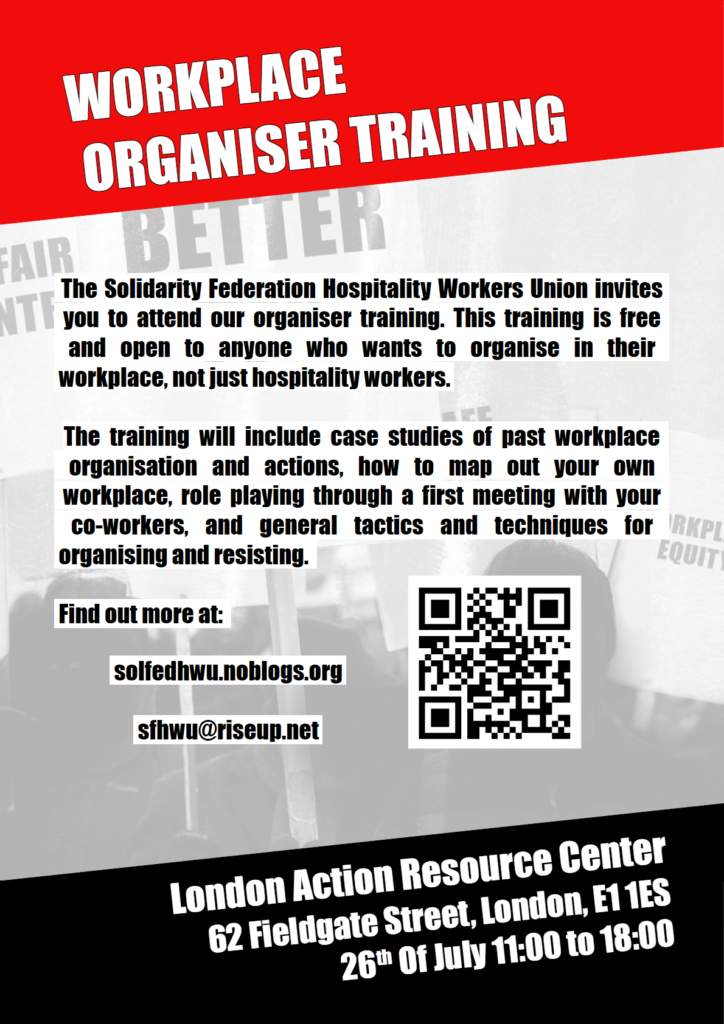
We Should Run Our Movements lays out an argument that movements for liberation should be organised from the bottom up instead of the top down. It is designed to be easy to print on a work or home printer, being a single sheet of folded A4, so feel free to print your own. It is available along with all our flyers in more versions, like block black and white and booklet, in our Materials and Flyers page. Full text below
CHANGE IS POSSIBLE
We face many problems today. From economic stagnation and poverty, to state violence and oppression, to crumbling infrastructure and services, to discrimination and hatred based on any number of characteristics, to the possibility of complete environmental collapse. Many of these problems have been with us for hundreds of years, or have flared up again after progress was seemingly made against them. Many of those in power are unwilling to address these problems, and they often benefit directly from them. Worse still, popular movements to solve these problems have only won temporary relief and have often acted as a stepping stone to power for their leaders instead of creating lasting change.
The repeated failure of both established rulers and their opponents within and outside of the formal structures of power has led many to doubt that real change is possible. All that seems possible is to replace one oppressive and exploitative ruling class with another, and people who hope to create a better world are nothing but useful tools for their new masters. This pamphlet will argue that this is not true, but that there are structural problems with popular movements that we need to confront if we want them to achieve real liberation.
MEET THE NEW BOSS, SAME AS THE OLD BOSS
Our current society is built on the failure of previous social movements. Liberalism promised to dismantle the traditionalist and patriarchal feudal system of obedience to lords and priests, only to create a nationalist and capitalist system of obedience to politicians and capitalists. Socialism promised to end capitalist exploitation of workers, only to replace it with exploitation by the state. Today far right movements are promising a better world based on strong leaders and ethnic nationalism, but if they succeed they will only create a new system of exploitation.
Besides movements that have seized power, those that have remained outside of the state have also sold out to the existing power structure. Most unions have become structures to empower their bosses instead of fighting for a better world for workers. Most co-operatives and charities have become indistinguishable from for-profit corporations. Most “radical” political parties adopt accepted political common sense and turn against their supporters long before they gain any power.
Even those organisations that remain in opposition to the established structure of rulership often end up creating their own internal systems of oppression and exploitation, which empower and enrich their leadership at the expense of their supporters. Small protest movements and isolated Marxist parties have often become indistinguishable from cults or pyramid schemes, opposing existing institutions but still recreating the kinds of exploitation and oppression that those institutions are based on.
RADICAL HIERARCHIES
These constant betrayals come from the fact that our movements often recreate the same structures as the institutions that they oppose. They build organisations that are based on the obedience of their supporters to a visionary leadership that will lead everyone to a better world. We are expected to donate time and money to them, to obey their orders, and trust that they are using their power for good. However, such obedience enables the leadership to exploit and oppress their supporters, as obedience inherently makes it harder to critique or resist abuse by the leadership.
Worse, in any structure in which the majority are powerless and only a select few have any power to act, those limited positions of power will be the site of intense competition; anyone who wants a real say in the direction of a movement must climb the hierarchy. But such competition tends to be won by those who are most willing to do whatever is necessary to gain power, including sacrificing their principles and the interests of their trusting supporters. Structures of obedience do not just create the possibility for exploitation and oppression, but also an incentive for those at the top to exploit and oppress in order to take and maintain power.
This is the same structure as we see in the hierarchies of the state and capitalism. Politicians must always put political power above all else if they are to seize power, and so can not break out of that necessity in order to change the world for the better, despite the power they have. Likewise, capitalists must always put profit above all else and must abandon any higher objectives in order to make money. This need to maintain power and profit is at the core of the problems we face today; using violence to force citizens into line, impoverishing workers with low wages, letting services fall apart to save money, pandering to bigotry and ignorance for quick political gains, and burning the environment for one more drop of power or an extra penny of profit. When we recreate these hierarchies in movements for change, we recreate the very problems we are attempting to solve.
RISE TOGETHER OR FALL APART
Part of the reason for our acceptance of hierarchies, despite the problems they cause, is that we often focus on one problem at the expense of all others. We see people who have other primary concerns as competitors who must be opposed instead of attempting to reach a mutual agreement in order to cooperate against all our problems. When male workers want better wages but are not willing to deal with sexism or racism in the workplace, the only way to bring women and racial minorities into the movement is through blind obedience and hierarchy building. When some feminists reject trans people, they must support structures that can suppress all women. When radicals ignore the material needs of the masses of society in favour of theoretical concepts, they can only gain the support of society through lies and oppression.
In order to reject obedience and hierarchies, we must accept the desires of those around us as valid as long as they do not directly harm others, and build our movements on the basis of free agreement and cooperation between everyone involved. Only then will we be in a position to build structures that are not based on treating some people as tools for the empowerment of others, because we will no longer need to suppress each others’ desires. With this, whatever leaders might arise out of our movements will not have access to the hierarchies of obedience that enable and encourage them to abuse and sell out their supporters.
TO BE FREE
If no one can be forced into obedience within our movements, then we need goals that can appeal to everyone. Such cooperation will require us not just to look beyond specific problems to the broader structures that create them, but also to look beyond specific desires to the broader desires that unite everyone. The first of these is the ability for people to act in the world. The desire to do this is behind many more specific desires. To be poor, to be ill, to be discriminated against, to be isolated, to be physically restrained, are all ultimately ways in which we are disempowered and prevented from acting. To be rich, to be strong and healthy, to be accepted as a full member of society, to exist in a strong network of friends and allies, and to be free from the violence of others are all ultimately ways in which a person is enabled to do what they want in the world.
But the ability to act means nothing if what drives us to act is ultimately controlled by another person; that would make us tools for the empowerment of someone else. We need to have the autonomy to decide for ourselves who we are and what we desire, free from the impositions of unwanted social roles. This need is often frustrated by the more subtle ways we are oppressed and manipulated in our society; the demand for us to be a masculine man or a feminine woman, or to be a good productive worker or a loyal citizen. The ability to act and the ability to self-define are, taken together, real freedom.
This kind of freedom is something that benefits everyone who has it. Even if two people want to do radically different things with their lives, they both need freedom of thought and action to do those things. All forms of exploitation, oppression, and abuse, even when they fall on different people in very different ways, can be boiled down to ways in which they restrict this kind of freedom. Freedom can be the basis of a movement without an oppressive hierarchy and without leaders who will become new rulers.
ALL POWER TO THE PEOPLE
Often people turn to democracy as a method of egalitarian organising, and the problems with our current political system are seen as a lack of real democracy. However, even a perfect democracy relies on the obedience of minorities in order to function, who may never be in a position to be part of a coalition majority. This still enables exploitation and oppression by majorities, and is still based on the denial of freedom of a significant section of society, even if not as large a section as is disempowered today.
Instead, our movements must be built on the basis of free association, free agreement, and consensus. People must feel free to leave and join organisations based on their own desires otherwise they risk being put in positions in which they become tools for others. Making decisions by ensuring that everyone is in agreement with any proposal before it is acted on enables everyone’s voices to be heard within an organisation, and no one is expected to follow a leader or policy they disagree with.
Larger organisations must be built from the bottom up instead of imposed from the top down, with groups based on free association and consensus. These groups then form groups of groups, such as networks, alliances, or federations, on the same basis. In this structure, groups can enter and leave larger organisations or projects as they see fit, and larger structures can only be maintained if they truly serve the collective desires of all the groups involved, which themselves should serve the individual desires of all their members.
ANARCHO-SYNDICALISM
Such an approach to movement building cannot rely on using state power to implement change, as the state itself is the type of top down hierarchy of obedience that we need to abandon to reach our goals. Instead, we need to base our movements in local issues, such as building radical unions in workplaces, community groups and mutual aid networks in our neighbourhoods, and anti-fascist and cop-watch groups to protect our movements from repression by the state and authoritarian political movements. These bottom up decentralised organisations can be responsive to local conditions and the specific desires of their members, as well as allowing us to fight locally for higher wages, lower rents, and better living conditions through strikes, protests, and other practical actions, even when we do not have the power to confront national problems.
From this local base, we must organise between these groups so that we gain the ability to deal with nationwide problems. Networks of activists that share information and build cooperation between groups. Federations of radical unions that can cooperate across the country to launch general strikes in order to oppose economy-wide exploitation and oppressive state policies. Alliances of renters’ organisations that can withhold rent nationwide to oppose rising rents. All built from the bottom up, based on agreement between groups instead of having any one plan imposed upon them from above.
Such a movement, or movement of movements, would not just be able to push for change from the established structures of social organisation, but would be able to eventually replace them entirely. With strong enough bottom up organisations in our workplaces and our communities, we would have the framework to run those workplaces and communities directly without the state or capitalism. This would be a real revolution, that would not just push back against the hierarchies of obedience that enable exploitation, oppression, and discrimination, but fully abolish and replace them.
This idea of how movements should be built and what they should aspire to has a name. Since it is based in a rejection of all obedience and rulership, and fully embraces freedom as the core demand of all struggles for a better world, it is anarchist, which comes from a Greek word meaning without (an) rulers (archy). Since it relies on a strategy of building bottom up power through radical unions and community groups, it is syndicalist, which comes from the French word for a workers’ union; syndicat. Combined, these are the politics of anarcho-syndicalism.