New Flyer – Protest is not Enough

We have another new flyer ready to share with the world! Protest is not Enough lays out the problem with protest as it is used today in Britain, what more effective forms of protest look like, and why we need to build power in our workplaces and our communities alongside protest movements. It is designed to be easy to print on a work or home printer, being a single sheet of folded A4, so feel free to print your own. It is available along with all our flyers in more formats, like block black and white and booklet, in our Materials and Flyers page. Full plain text available below the pdf on this post.

THE RIGHT TO PROTEST

The right to protest is a key right within our political system, and the suppression of protest is a sign that a government has become oppressive and authoritarian. Protest is seen as the voice of the people, and an important tactic to raise issues and push for changes that the political system would otherwise ignore.

However, protest has also had a very uneven record of bringing about such changes, especially on its own without other forms of political action. This pamphlet will argue that this is due to the limited ability of passive protest to effect politics, and will discuss other tactics outside of the formal political system that are needed in order for people to assert their interests against a government that often does not care about them.

WHEN GOVERNMENT FAILS

Protest is seen as a necessary part of a healthy society because our political system often fails to represent the interests of the people living under it. This is clear within an absolute dictatorship, in which a dictator has no formal responsibility to care about the wants and needs of their subjects, and can exploit and oppress them at will. The current “democracies” of the world are also far from perfect. Those of us who live under these democracies have no ability to veto any decision our government makes, no matter how unpopular that decision might be. Instead, we must wait for the next election, and even then there is no guarantee that any of the parties running for election will represent our views. Even within a theoretical perfect democracy, minorities can be ignored by the government.

This means that often we need to take action outside of the formal political system to make ourselves heard and put pressure on that system when it starts to behave in ways that are oppressive, exploitative, or negligent. Without such action, there is a risk that the political system will stop serving its subjects at all, and will become more and more insular, detached, and corrupt.

In our current society, protest is often the go-to tactic for trying to push against the political system when it starts to go off the rails. A mass of people on the streets is seen as a message to the government that people are unhappy with their policies, and that they should change their ways in order to maintain popular support. On almost all issues, the organisation of protest is the main tactic of political movements aside from running in elections.

A RIGHT WITHOUT TEETH

However, the reasons why protest is necessary and the legal and cultural ideas around what constitutes a legitimate use of protest are at odds with each other. Protest is necessary to restrain state corruption, malice, and negligence, yet acceptable and respectable protest tactics are often defined by being as peaceful and as non-disruptive as possible. The standard framework for such a protest is that everyone masses at point A, marches to point B in accordance with the instructions and limitations put on them by agents of the same government they are protesting, and then goes home.

The great flaw in such acceptable forms of protest is that they are just statements of discontent and do not put any immediate pressure on the government to change its behaviour. While a sufficiently large peaceful protest may make the current government worry about how people will vote in the next election, it does not do anything to force them to stop what they are doing right now. This is even more true when the issue is one that only affects a minority and so can be easily ignored in an election. Such pressure also has little effect on issues in which all the main political parties are in agreement; in such a situation there is no alternative for disgruntled voters to turn to.

DISRUPTIVE PROTEST

The alternatives to the acceptable protest, in which we are allowed to protest only in so far as we do not actually put any pressure on the government, are more active and disruptive forms of protest that attempt to impose costs on the government if it continues with a harmful policy. This can range from non-violent civil disobedience, to refusal to cooperate or pay tax, to more active and lively blockades, and up to vandalism and riots.

It is not the place of such a short pamphlet to discuss the practical or ethical pros and cons of the tactics within the umbrella of “disruptive protest” or advocate for any particular approach. However, it is important to move beyond a model of protest as a way of showing discontent to a model of protest that imposes costs on oppressive and exploitative behaviour and pressures governments to avoid such behaviour. Without a willingness to do so, protest has no ability to restrain a government, as they can simply ignore protests without any fear of consequences. The right to protest is worthless if it is only a right to ineffective protest.

AT HOME, AT WORK

To be truly effective, our protests must also move away from a focus on the formal political system. While the government often enables and supports institutions that profit off of human misery, such institutions can still be confronted directly without having to rely on government action. For example, companies that profit from and support harmful state policies, such as arms manufacturers, oil companies, or corrupt service providers, can be directly targeted by disruptive protests or boycotts that put pressure on them to change their behaviour.

Many of the problems that we face are also not just political but more broadly social and economic in nature. Often our landlord or employer has a more direct influence on our lives than the government does, and things like high rents, low wages, and bigotry and abuse by petty authorities are the base cause of a series of other social ills. These problems can be confronted by labour strikes, rent strikes, boycotts, and other disruptive action.

Such organisation and protest around local economic and social issues has advantages over purely political protest. It allows for movements to be effective even when they are too small to directly confront the state. For example; It may take millions of people to force a government to take action on low wages, but we only need our co-workers to strike for higher wages in our specific workplaces, or some local allies to picket a local business that is behaving is a racist or sexist manner.

Starting with local bottom up organising and building up from there also creates more durable a capable movements. A protest movement that is built from the top down around a single pressing political issue will start to demobilise and disintegrate after that campaign is over, and any new campaign over a new issue will have to start again almost from scratch. Bottom up movements can continue to operate locally and maintain knowledge, relationships, and infrastructure in-between big unifying campaigns. They do not just create one off protest movements, but also build long term capacity within society to organise and to protest.

DIRECT ACTION

The next step to improve the effectiveness of our movements is to operate beyond the logic of protest and incorporate the principal of direct action. Direct action is the idea that instead of putting pressure on an institution to implement a change that we desire, we organise to achieve that change directly. This can be constructive, such as organising a food cooperative or a mutual aid network to directly provide services that the state or capitalism will not, or it can be obstructive and focus on protecting us from harm, such as organising anti-raids or anti-fascist groups to directly prevent nationalist and racist thugs from threatening our communities, whether those thugs are state sponsored or not.

Direct action is important because protest, even when successful in pushing an institution to change, still leaves the implementation of that change in the hands of the very leaders who had to be forced into adopting it. Such leaders cannot be trusted to act in good faith, and they will often implement reforms in the weakest way possible, backslide later, or simply lie about their intentions and fail to implement any reform at all. Sometimes the best way to achieve something is to do it ourselves.

ORGANISING AS EQUALS

Many previous movements for social justice have been channelled into serving the interests of their leaders instead of the interests of the people they claimed to help or represent. Many formal, top down charities have become more about keeping their executives well paid than about helping people. Workers’ movements like the trade union movement and the cooperative movement have drifted from their original objective of empowering workers to becoming more and more similar to the capitalist businesses they were created to oppose.

To avoid this kind of failure and build more reliable movements we need to avoid creating structures in which one person or group of people, even if they are elected, sits at the top of an organisation and dictates what to do to everyone else. We need to build these organisations on mutual agreement and consensus so that no one can be ignored. We also need to build them from the bottom up, with each local organisation running its own affairs according to the knowledge and insight of those who actually work and live within that local area, so that we avoid creating a new unaccountable hierarchy.

Hierarchies in which those at the top can command and ignore those below them are the problem that causes the need for protest and resistance in the first place. Our political leaders can act without any real accountability to those below them, and this is why movements outside of the formal political system are necessary to keep them in check. If we simply recreate such hierarchical structures within our movements then we will recreate the same kind of problems we are struggling against.

The principles behind protest and direct action themselves are incompatible with blind obedience to leadership, as they are founded on the idea that people have the right and the ability to look at society, decide what needs to change, organise with like minded allies, and take action to create that change regardless of what those above them think. Indeed, previous movements that became more hierarchical often had to abandon disruptive protest and direct action because such tactics undermined the obedience that the leadership relied on to control those movements.

DUAL POWER

As bottom up organisations grow, they can network, form alliances, and even form federations that allow them to cooperate with each other and achieve more than they could alone. A small group might only be able to deal with very specific local issues, but an alliance of such groups across a country can deal with nationwide issues. They can form a system of popular power that is completely independent form the state and capitalism and is not reliant on the whims of politicians or property owners to ensure that peoples’ desires are met.

A network of peoples’ councils spread throughout communities and workplaces, that is organised from the bottom up to truly empower its membership, would have effective control over much of the real infrastructure of the area it operates in. Workers could refuse to manufacture dangerous goods or implement unfair management decisions. Evictions, immigration raids, and arrests could be prevented. Exploitative rents, taxes, charges, and prices could be ignored. Unpopular laws could be made completely unenforceable. Important resources and infrastructure could be seized and run by workers and service users in the interests of all those involved instead of to enrich capitalists and empower politicians.

All of the above has been achieved by past mass movements willing to take up disruption and direct action to achieve their aims. Corrupt or incompetent governments and exploitative capitalist businesses can be marginalised and ignored to the point that it is impossible for them to impose anything upon the people theoretically under them. The full development of such an alliance of local organisations for protest and direct action could not only provide us with far more potent tools to prevent the abuse of power by politicians or capitalists, but also give us the basis to abolish them entirely and run society in the interests of everyone.

ANARCHO-SYNDICALISM

The fact that protest is seen as so vital to a free society in order to keep political power in check indicates that our current political system does not in fact serve the desires of its subject without outside pressure. If we can build a movement that can articulate and further those desires in spite of, or against, an uncooperative government, then we will have built structures that are both more powerful than the state and more capable of serving our needs. At that point, it would only be sensible for that movement to do away with the state and organise society directly on its own. This would be a revolution that truly empowered and protected people instead of simply subordinating us to a new set of rulers.

This approach to building movements has a name. Because it is critical of hierarchies and all other forms of rulership and seeks to organise without resorting to that rulership, it is anarchist, which literally means without (an) rulers (archy). Because it seeks to build working class power though organisations in the workplace and the community, it is syndicalist, which comes from the French word for a workers’ union. Together, these two ideas form Anarcho-Syndicalism.
New Flyer – Towards a Better Union

We have a new flyer ready to share with the world! Towards a Better Union lays out a critique of mainstream trade unionism and argues for a specifically anarchist and syndicalist approach to workplace organizing. It is designed to be easy to print on a work or home printer, being a single sheet of folded A4, so feel free to print your own. It is available along with all our flyers in more formats, like block black and white and booklet, in our Materials and Flyers page. Full plain text available below the pdf on this post.

A BLEAK FUTURE

The trade union movement has been extremely important in furthering the desires of workers and improving our living conditions. This movement was vital in raising many workers out of the gruelling fourteen hour days, unsafe working conditions, poverty pay, and general degradation of the industrial revolution.

However, the modern trade union movement seems unable to extend or defend those gains. For many workers, the next decade looks like it will be bleaker than the last, and in the long term we may be slowly sliding back to the soul crushing working conditions of the 19th century. In the face of this, modern unions often seem to lack the ability to effectively stand up for their members. They are also often wracked with problems of internal abuse and a lack of accountability to their membership.

This pamphlet will argue that this failure is inherent to the way that modern unions are structured, and that in order to defend the interests of the working class we need to build a better kind of union with a radically different structure. However, before that, we will explore why the trade union movement developed in the first place and what the purpose of those early unions was.

CAPITALISM

Trade unions developed as a reaction to the growth of capitalism. Before capitalism, most families were broadly self-sufficient, either working the land as peasant farmers or creating things for sale with their own tools as craftspeople. These farmers and craftspeople were not free from exploitation, often owing a portion of their produce to an aristocrat, the church, or a craft guild, but they were often capable of providing for themselves as individuals, families, or communities without the aid of their exploiters.

Capitalism changed this. As technology developed and production became more and more dependent on expensive machinery, it became harder and harder to produce anything efficiently without access to that machinery. In this situation the vast majority of people could no longer be self-sufficient and provide for themselves with the tools they owned, and they had to sell their labour to those rich enough to own the buildings, machines, and other means necessary to produce.

Society became divided between workers in need of employment, and capitalists in need of employees. A worker who could not find an employer faced poverty and starvation, but a capitalist who could not find workers could sell their capital and live off the proceeds, giving capitalists the advantage. The capitalist also had an incentive to use this advantage to exploit workers, as capitalists are only in business to make a profit, and paying lower wages and demanding more work increases profits. This is the basis for the name capitalism; a society in which those who own capital hold power and run the economy in the pursuit of profit.

This was not just a quirk of technological development. The developing nation state also often forced poverty and dependence on many of its subjects; stripping peasants of land and giving it to the developing capitalist class, suppressing small craft production by law, and policing the developing working class. A population dependent on their masters to survive did not just enable exploitation by capitalists, but also enabled tighter control by governments.

UNIONS

With a capitalist class driven to exploit the workers, and the state siding with capitalists over the working class, workers needed their own organisations to fight for their interests. And while an individual worker might be replaceable, any workplace could be ground to a halt if workers resisted collectively. This gave rise to the first unions and the use of strikes as methods to fight for workers’ interests against a ruling class that saw them only as tools.

As unions grew, they also realised that what was true of the workplace was also true of the economy more broadly; one worker or workplace may be expendable within the economy, but a united working class could bring the entire economy to a halt, and not only put pressure on individual capitalists, but on the capitalist class as a whole and even the nation state.

This was the basis of trade union movement; the use of the collective economic power of the working class to fight for better lives for workers regardless of what capitalists or politicians wanted. However, the modern trade union movement has drifted far from this idea.

INDEPENDENCE

The original unions were not legally recognised. While this caused many problems for them, it also meant that they were independent from both the state and capitalism, relying on their working class membership for their power. They had to serve working class interests or they would lose their only base of support.

This is not the case for the modern trade union movement. Unions have become legal entities, and with this legal recognition the union movement has integrated itself into the state and social democratic political parties like Labour. However, that state has never reliably been on the side of the working class and even left wing governments often suppress strikes, as working class radicalism is as much a threat to state power as it is to capitalist profits.

This has put unions in an awkward position where they must serve two masters. Some of their power comes from the support of the workers, but some of it comes from recognition by the state. Many of the most disruptive tactics that a union might use to win disputes are currently illegal, and unions will be held liable if their members use those tactics. A legally recognised union must then police the militancy of its own members in order to maintain itself, even if this is against the interests of its membership. Unions have become an enforcer of government policy instead of an instrument of working class interests.

HIERARCHY

Trade unions could make such compromises with the state because their internal structure never really represented all of their membership. While most unions make a show of being democratic, that democracy means that, at best, a union can only ever represent a majority of its membership and can ignore the desires of minorities within the union.

Modern trade unions are also universally run from the top down, even if those at the top are elected. This means that the membership only has limited control over the leadership. Workers may elect them, but outside of elections the union leadership can do whatever it wants, and the membership has a little to no ability to veto the decisions of their leaders.

This leads to a situation in which trade unions do not represent their membership, but instead recreate the relationship between workers and bosses in a workplace hierarchy where the boss has the last say. The workers within a trade union do not collectively decide how to use their collective power in pursuit of their shared interests, but give up that power to union leaders who often use it to serve their own interests.

VISION

The development of a reliance on state recognition and an internal hierarchy means that the modern trade union movement does not reliably serve working class interests. Often unions suppress militancy and initiative amongst their own membership, allow people higher up in the union hierarchy to abuse their position, negotiate compromises with employers without a mandate from the workers they claim to represent, and act to preserve their relationship with the state and the stability of their internal hierarchy over taking action to improve the lives of workers.

But this failure has far wider consequences beyond practical day to day struggle. It also makes the trade union movement incapable of developing a consistent and useful vision of what a better society for workers might look like, as it cannot fully embrace the interests of the working class. When the state cares about its own power and the profits of capitalists over the needs of workers, which is the normal state of affairs even under left wing governments, the trade union movement suffers from conflicting loyalties, both between its members and the state, and between its rank and file membership and its internal hierarchy.

Mainstream unions may have been able to balance these competing interests when the system of state and capital was stable and growing and could afford to pay off the unions and the working class while maintaining profits. But, as that system starts to fail and become unstable, those old compromises fail with it, and unions are so firmly integrated into that system that they cannot advocate for anything that might destabilise it, no matter how much harm this failure causes the working class. Conflicting loyalties have left unions paralysed.

Compared to the early unions, which were often hotbeds of working class intellectual development and critique of state and capital, and helped develop radical ideas like socialism and communism, the modern union movement is in a sorry state. Modern trade unions are often deeply conservative organisations, incapable to radical change even when a radically changing world demands it.

BEYOND THE WORKPLACE

This lack of a broader vision has also isolated most unions from other social movements. Early unions were not only integrated into a broader working class movement of mutual aid, education, self-help, and struggles by renters and the unemployed, but also attempted to coordinate internationally in response to the increasingly global nature of capitalism.

The core insight that led workers to form unions, that workers had strength together and that solidarity was our best weapon against capitalism, has been lost. Most unions do not attempt to build networks or alliances with other workers’ movements or even other unions. Partly this is because the legal framework they have accepted often prevents things like solidarity strikes in support of other organisations, and partly this is because the union hierarchy is more interested in its own power within the union than building the collective power of the working class in the global economy.

The result of all this is that most modern trade unions are more like insurance companies than grass roots workers’ organisations. They often have very little rank and file involvement and treat rank and file initiative as a threat to the internal hierarchy. They have no coherent strategy to advance working class interests and they have no theory that might provide a basis for such a strategy. They are often more interested in controlling and suppressing any militant impulses among workers than helping us to fight for what we want. The trade union movement has failed as an engine of working class interests, and that failure is based in their adoption of internal hierarchy and their abandonment of independence.

ANARCHO-SYNDICALISM

None of this criticism is a rejection of the idea that workers should organise amongst ourselves in order to further our own interests. However, such organisation needs to be completely independent of the state or any other institution which might have conflicting interests with the working class. Our unions must serve our collective interests as workers first and foremost, otherwise they become a mechanism for controlling us.

We also need to avoid creating a hierarchy in which some people sit at the top the organisation and dictate to everyone else what to do. We need to build new unions on mutual agreement and mutual consensus so that no one can be ignored. We need to build them from the bottom up, with each local branch running its own affairs on the basis of the ideas and desires of its rank and file, instead of just empowering a new class of bosses over the rank and file.

However, we also need to look beyond the local branch and the individual workplace. We need to develop solidarity not just in the workplace, but between workplaces, and between workplace struggles and broader social struggles. The working class is strongest when we act together, and that principal applies from the individual workplace all the way up to the global economy.

We must also not be scared of the implications of our own power as the working class. The capitalist class and the state do whatever they can get away with, while we often tie one hand behind our backs and seek some kind of mythical “fair compromise”. The working class, if united and organised, could run the entire economy in our own interests without capitalists or politicians. This would be a genuine worker revolution instead of simply changing one set of bosses for another. Any organisation that genuinely represents working class interests should constantly push towards a worker controlled society, and develop the collective power of the working class until such a society can be achieved.

This approach to unions has a name. Because it is critical of hierarchies and all other forms of rulership and seeks to organise without resorting to that rulership, it is anarchist, which literally means without (an) rulers (archy). Because it seeks to build working class power though organisations in the workplace and the community, it is syndicalist, which comes from the French word for a workers’ union. Together, these two ideas form Anarcho-Syndicalism.
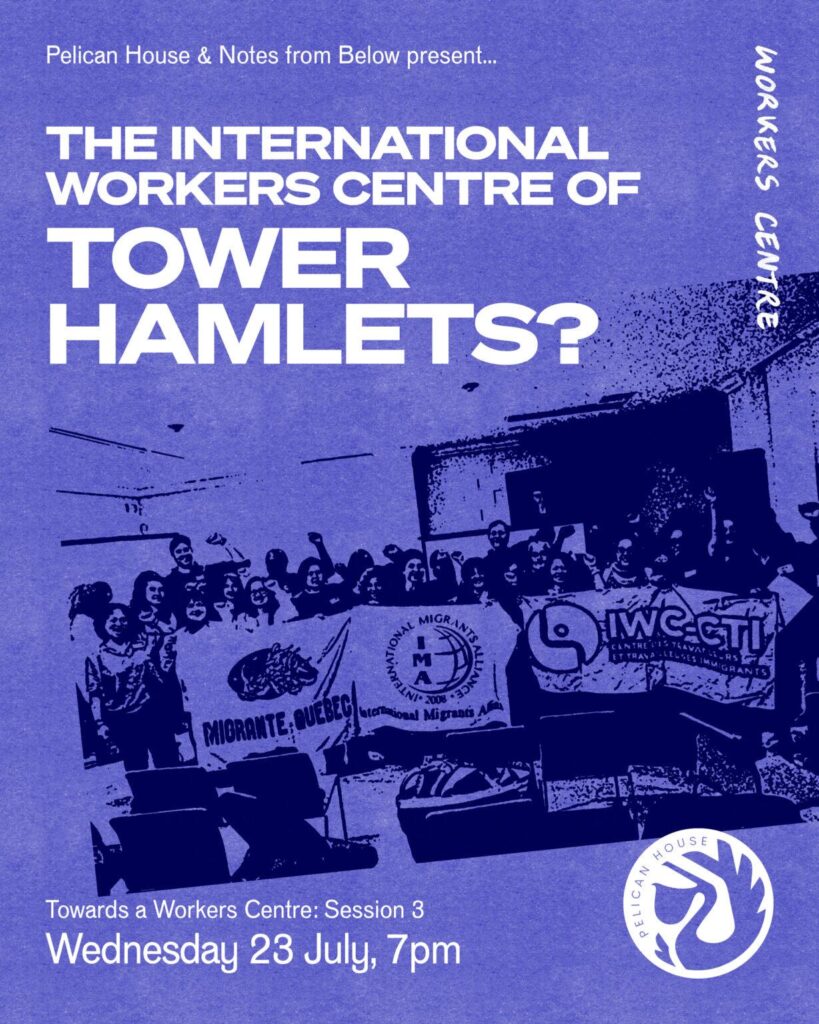
Towards a Workers Centre: Building Worker Power in Tower Hamlets?

An event organised by Notes from Below:

Workers Centres have proven transformational for local organising initiatives, ranging from the defence of migrants to the waging of workplace struggles. Across this three-part series of discussions and workshops, we will explore what it would mean to establish a Workers Centre at Pelican House.

Join us to hear about the experiences of worker centres internationally with Janice Fine, followed by a roundtable discussion on the local challenges and opportunities in Tower Hamlets. Worker centres are community-based organisations that provide support and resources to low-wage and immigrant workers. They often focus on campaigning for workers’ rights, providing education and training, and helping workers navigate the law and regulation about work. After the speakers, there will be a practical workshop on building a worker centre in Tower Hamlets!

23 JULY- EVERYBODY WELCOME – NO PRIOR EXPERIENCE NECESSARY !! 

Admission is free, though a £5 donations is suggested to support programming at Pelican House!

Pelican House, 144 Cambridge Heath Road, Bethnal Green, E1 5QJ

Arrive from 6pm

Discussion begins 7pm

Social from 8:30pm

The venue has level access throughout and an accessible toilet.

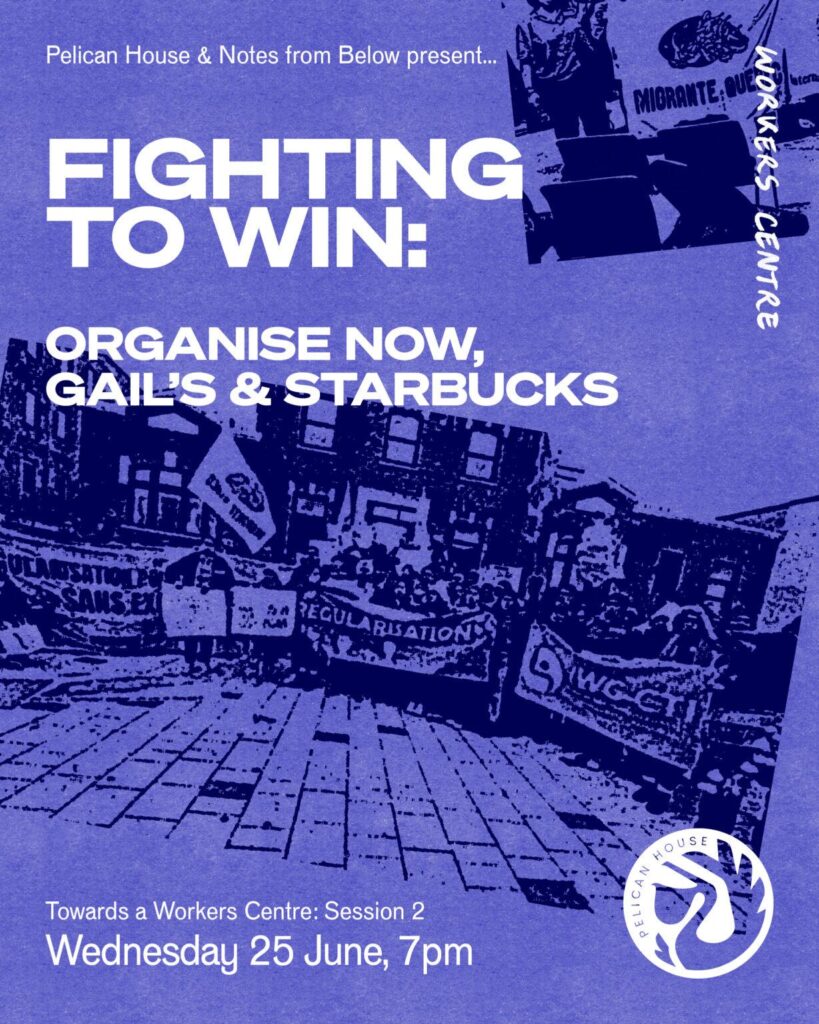
Towards a Workers Centre: Fighting to Win – Organise Now, GAIL’s & Starbucks

An event organised by Notes from Below:

The international network of neighbourhood Workers Centres has proven transformational for local organising initiatives, ranging from the defence of migrants to the waging of workplace struggles. Across this three-part series of discussions and workshops, we will explore what it would mean to establish a Workers Centre at Pelican House.

Join us for a workshop to discuss the ongoing Organise Now x BFAWU campaign to unionise GAILs. The panel will feature hospitality workers, union organisers, and volunteers discussing how we can organise in non-union workplaces. We will also hear from a special guest from the Starbucks campaign in the US! Come and join the session if you work somewhere without a union, want to support a new union campaign, or just want to learn more about organising at work today.

25 JUNE – EVERYBODY WELCOME – NO PRIOR EXPERIENCE NECESSARY !! 

Admission is free, though a £5 donations is suggested to support programming at Pelican House!

Arrive from 6pm

Discussion begins 7pm

Social from 8:30pm

The venue has level access throughout and an accessible toilet.