We believe that the law is mostly a tool that the rich and powerful use to keep the working class in line, that the rich and powerful often get to ignore their own laws, and that relying on the law to protect us in the long run will only result in disappointment. The limited rights we have now often only came about due to workers fighting for them, and we need to keep fighting to prevent them from being taken away. Workers can only protect ourselves by building our own organisations and power in the workplace and the community which can oppose the state and capitalism.
However, it is still useful for workers to know our legal rights. They can be a easy way to get an overbearing boss or landlord to back off, and they can create breathing room for us to organise together and take action that not only gets us what those above us are willing to give us, but what we really desire.
These rights change with the whims of whoever is in government, so some may have changed since this page was last update. This page was last update in June 2026.
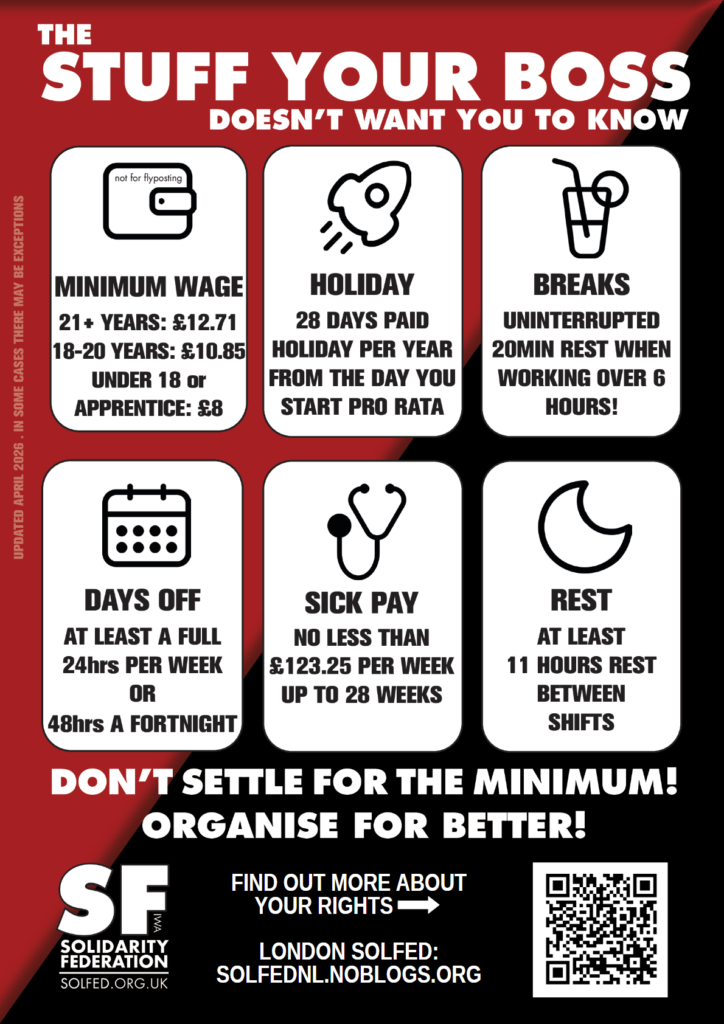
Stuff Your Boss Doesn’t Want You to Know
Whether we’re working temporarily or permanently, with an agency, full or part-time, we have certain basic rights:
Pay
We have the right to be told in writing how much and when we’ll get paid. There is also a legal minimum wage that everyone has a right to. This wage varies by age:
- Over 21 – £12.27 an hour.
- 18 to 21 – £10.85 an hour.
- Under 18 – £8 an hour.
- Apprentices – £8 an hour if under 19 and/or in your first year, and then the normal minimum wage according to your age.
The rates are updated every year in April. Find out more here
Leave
We have the right to at least 5.6 weeks’ paid leave (holiday) per year for full time workers. This amounts to 28 days for a normal working week. Job contracts should say what you get but if they don’t, then 28 days is the minimum (including public holidays) unless you’re part-time.
For part-timers, multiply an average working week by 5.6. The rule applies to all jobs, no matter how casualised. It applies from the day we get a job.
Find out more here
Breaks
We have the right to breaks of at least 20 minutes if we do over six hours of work. We are allowed at least 11 hours’ rest in every 24 and a minimum of a day off a week or two off per fortnight.
Rest breaks for under-18s are a minimum of 30 minutes every 4 1/2 hours, with 12 hours rest every 24 and minimum of two days off a week.
Find out more here
Hours
We have the right to refuse to work more than 48 hours a week. We can’t be made to go beyond that unless we have agreed in writing. This is worked out by averaging a 17-week period, so we can be forced to do more in any single week.
Night workers can not work more than an average of 8 hours in a 24 hour period, again worked out by averaging over a 17-week period. People under 18 can not work more than 8 hours a day and more than 40 hours a week.
Certain jobs are have exceptions to these rules. Find out more here
Sick Pay
We have the right to sick pay. We get statutory sick pay from the first day off sick for up to 28 weeks if we are classed as an “employee”. Sick pay is £123.25 per week or 80% of average weekly earnings, whichever is lower.
Find out more here
Maternity/Paternity Pay
We have the right to maternity/paternity leave when we have children. Most mothers are allowed 39 weeks’ paid maternity leave plus 13 weeks’ unpaid leave. To get maternity (or paternity) pay we must earn at least £129 per week and have been working continuously for more than 26 weeks by 15 weeks before the baby’s due date (when the employer needs to be notified). For the first six weeks we should be paid 90% of average earnings, then a constant rate of £194.32 for 33 weeks or 90% of the average weekly earnings, whichever is the lowest.
If we are not eligible for maternity pay we can then apply to get Maternity Allowance from the government. Fathers/male partners get two weeks’ paid paternity leave. Alternatively, eligible parents can share up to 50 weeks of parental leave in the year after a child’s birth.
Find out more here
Harassment and Discrimination
We have the right to be free from harassment. We should all work without racial or sexual harassment, prejudice, or discrimination. Agency and part-time workers have the same rights as full-time workers. We should not be discriminated based on the following protected characteristics:
- age
- disability
- gender reassignment
- marriage and civil partnership
- pregnancy and maternity
- race
- religion or belief
- sex
- sexual orientation
Aside from these protected characteristics, we also have right to be free from abuse, intimidation, humiliating, and bullying behavior.
Find out more here
Unions
We all have the right to protection from being sacked (fired, “let go”) for using our legal employment rights. We also have the right to join with our fellow workers and organise ourselves collectively and to join a trade union. Employers can NOT do any of the following:
- Offer you benefits to encourage you leave your union
- Threaten you to intimidate you over union membership
- Discriminate against you for legal union activity
- Fire you for being a member of a union
Find out more here
Health and Safety
We have the right to refuse work that is unsafe or where training is not given. We all have the right to refuse to work if we find ourselves fearful of danger. Agencies are not allowed to send us to jobs for which we are not qualified, and they must see that proper training is given. Employers should:
- Give us decent working conditions including enough toilets, washing facilities and drinking water.
- Make a health and safety plan, then give staff proper info and training.
- Give us procedures for dealing with risks at work.
- Tell all workers about health and safety agreements, policies and practices before we start work.
- Consult on health and safety matters. Health and safety at work costs money and time, so bosses often try to dodge doing it. By law they must give healthy, safe conditions to everyone they hire.
Remember, we can legally walk out if you feel in immediate danger. Some industries are covered by additional laws. Find out more here
Pensions
We have the right to a workplace pension. If we are classed as a worker, aged between 22 and state pension age, and earn more than £10,000 a year then our employer must automatically enroll us in their workplace pension scheme, although we also have right to opt out. In most circumstances our employers can not refuse to enroll us in their workplace pension scheme if we ask to do so, even if we do not qualify for automatic enrollment.
Our minimum contribution to a workplace pension scheme is 8% of our earnings, of which our employers must pay a minimum of 3% of our earnings as long as we earn more than £520 a month or £120 a week or £480 over a four week period.
Find out more here
Grievance Procedures
ACAS (an independent body which intervenes in boss vs worker disputes) has a Code of Practice which says when we can legally file a grievance (an official complaint). The Code doesn’t apply in court and it won’t always protect us from being sacked due to a disciplinary issue. The Code is considered by employment tribunals, other than for redundancies and when a firm decides not to renew a contract. A tribunal can sometimes change the amount of compensation we’re paid for being wrongfully fired (by up to plus or minus 25%) if it has not been reasonably followed. Employees facing disciplinary action should be given adequate time to prepare a defence.
We should be able to give evidence and to call witnesses. We have the right to go with someone else. They can be a full-time union official (whether or not the union is recognised), a registered lay official (someone union-trained to go to hearings) or a colleague. The worker and companion have protection against any disciplinary or dismissal in connection with using this right. Hearings must be heard within a reasonable time period.
Find out more here
Demand More, Fight for More
Many of our workplaces may offer additional benefits above and beyond these, we should always check our employer’s policies and hold them to those policies when they break them.
However, employers can get away with anything they are allowed to, and the government often does not hold them properly accountable. If we want to protect what we have and fight for even better conditions, we have to organise with our co-workers.
Find out more here